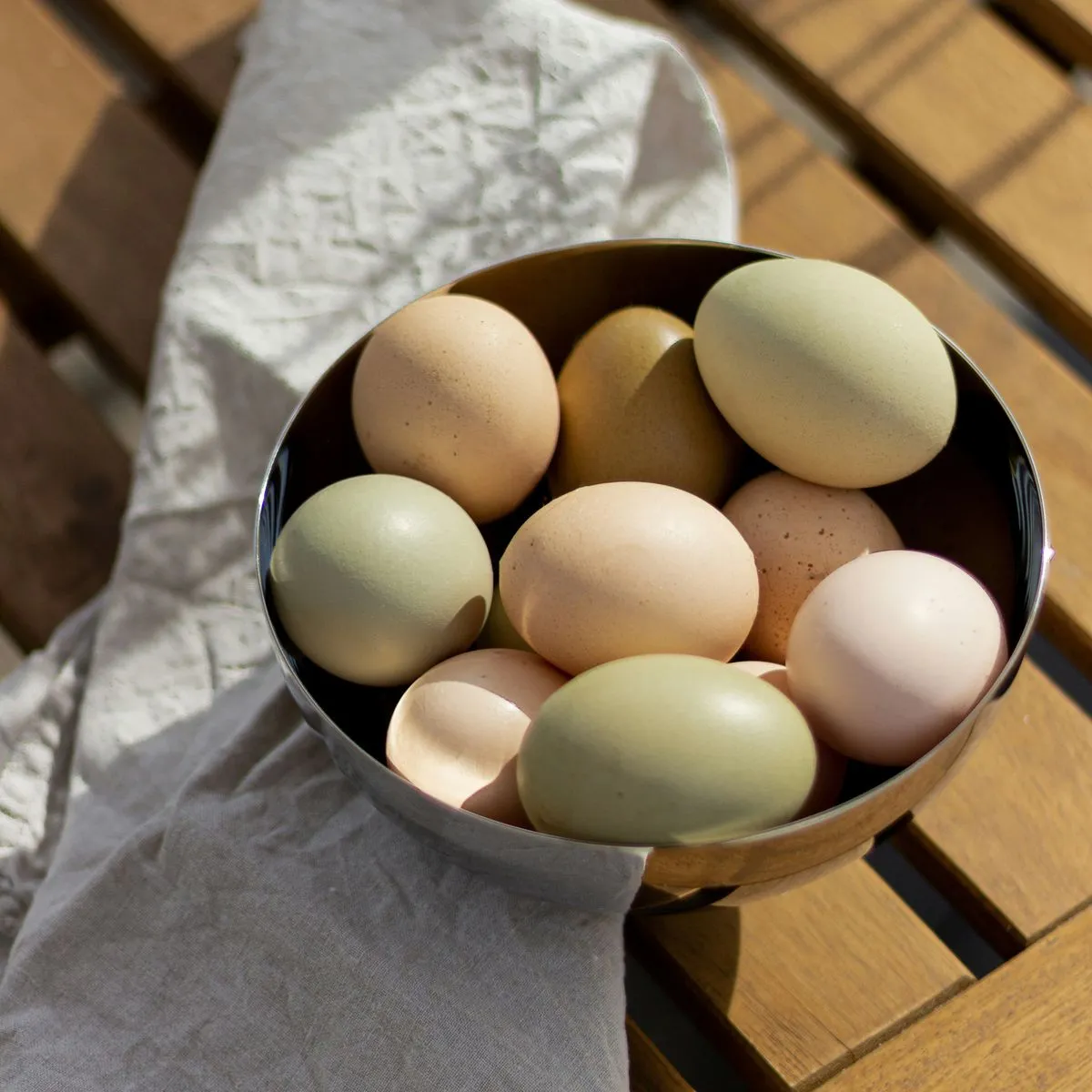
Four hens will make you breakfast for eight. Nobody tells you this before you get the coop. By midsummer you have a dozen eggs on the counter, another dozen in the fridge, and a laying schedule that does not care about your appetite. Backyard eggs turn out to be the single most-wanted listing on rootr., and the one that makes the most new friends.
There is a reason this post lands on the summer solstice. Today, your hens are working harder than they will all year.
why the solstice is peak egg
A hen’s ovary runs on daylight. Specialized photoreceptors deep in the brain, not even in the eyes but in light-sensitive cells in the hypothalamus, measure day length. Once a hen is getting roughly 14 or more hours of light, that triggers the hormonal cascade that releases a yolk to begin its journey. A hen in full lay produces an egg about every 24 to 26 hours, which is close to the biological ceiling.
Right now, at the June solstice, day length is at its maximum for the year. Your flock is as near to laying an egg a day per bird as it will ever get. Four healthy hens in their first or second summer can easily give you two dozen or more eggs a week. Hence the counter situation.
Enjoy it, because it will not hold. As the days shorten after midsummer, laying tapers. Come fall, most hens molt, dropping and regrowing their feathers, and pause laying almost entirely while they spend their protein on plumage instead of eggs. Production will not fully rebound until the days lengthen again in late winter, unless the coop is artificially lit, which many keepers deliberately skip to give the birds a natural rest. So the summer surplus is not just abundance. It is seasonal abundance, here now and gone by Halloween, which is all the more reason to move it while it flows.
why eggs move so fast
Eggs are the perfect swap object. They are universally understood, already portioned, and they need no story. A carton on the porch reads instantly as fresh, local, real. There is none of the “is this weird?” hesitation that slows down a jar of homemade anything. Everyone already knows exactly what to do with a good egg.
They also punch above their weight nutritionally and travel well, sturdy in their own shells, needing no refrigeration for the walk down the block. Few surplus items are this easy to give and this easy to say yes to.
the honest label, and the bloom
Here is a genuinely useful piece of hen biology. As an egg is laid, the hen coats it in a natural, invisible protective layer called the bloom, or cuticle. That coating seals the shell’s thousands of tiny pores and keeps bacteria out. It is why farm-fresh, unwashed eggs keep for weeks on the counter in much of the world.
This is also the one real difference between your eggs and the grocery store’s. In the US, commercial eggs are washed and sanitized before sale, which strips the bloom, so they legally must be refrigerated from then on. Your unwashed backyard eggs are the opposite. Leave the bloom on, do not wash them until just before you cook, and they store beautifully cool and dry. Wash one and you have started its refrigerator clock.
So say two things on the label and you have said everything a neighbor needs:
- When they were collected. “Collected Tuesday.”
- Whether they have been washed, and how they have been kept. “Unwashed, kept cool,” or “washed, keep refrigerated.”
One line of masking tape, “collected Tuesday, unwashed, keep cool,” is all the trust anyone needs. If a neighbor is ever unsure about an egg’s age, the float test settles it. A fresh egg sinks and lies flat in a bowl of water; as it ages the internal air cell grows and the egg stands up or floats. A floater is past its prime.
the return current
Here is the part that surprises new keepers. Eggs do not move in one direction. The neighbor who grabs a half-dozen this week has a lemon tree, or too much basil, or a standing sourdough habit and extra discard, or a fig that is about to bury them. Eggs are the opening move in a swap loop, not a handout.
That is the quiet advantage of a high-demand, everybody-wants-it item. It introduces you to the whole block. You give breakfast in June, and the block gives back all summer and into fall, right about when your hens go quiet and it is your turn to be on the receiving end. The egg economy is not charity. It is the first trade in a relationship that pays you back in seasons you are not even laying.