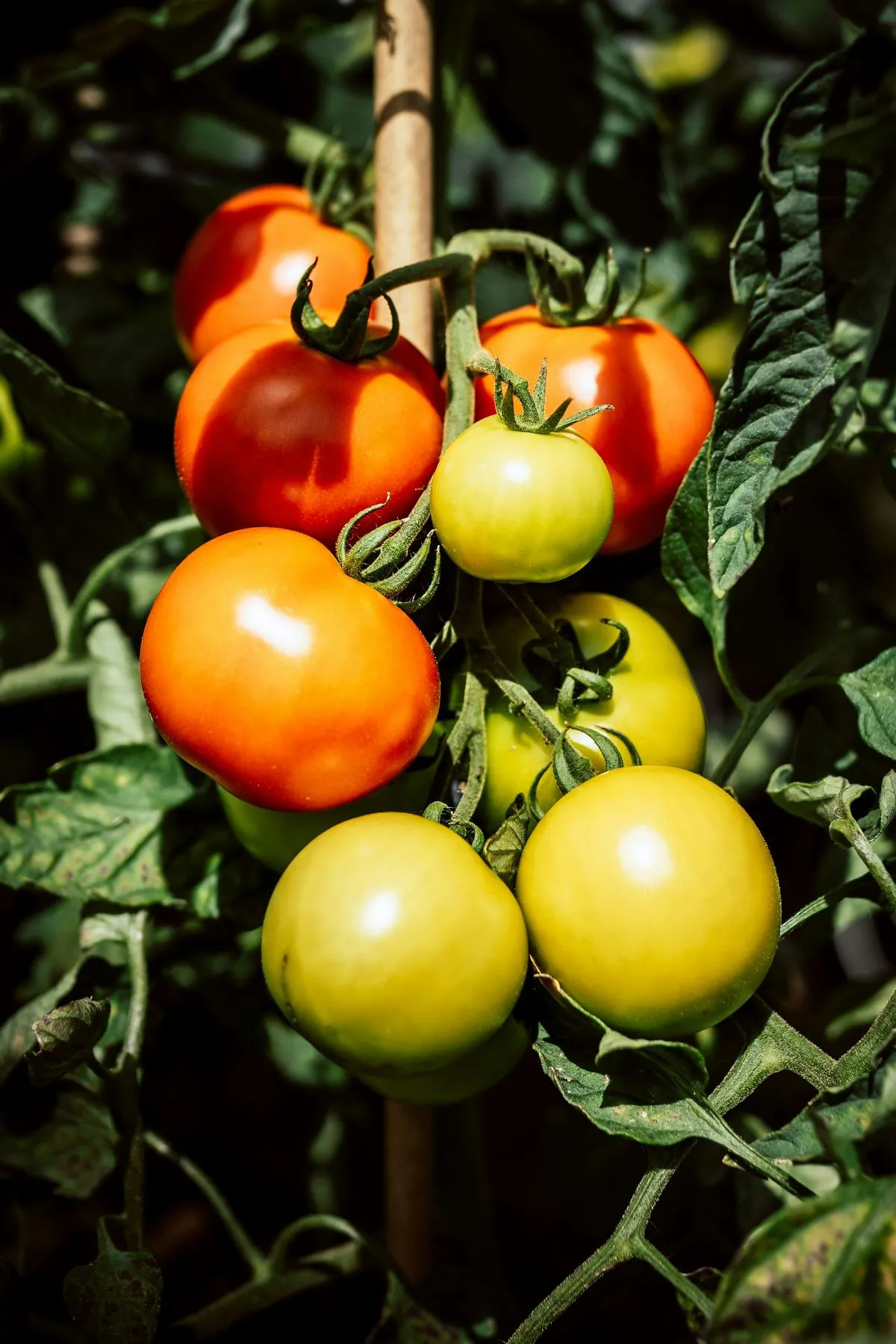
There is a specific week in late summer when every tomato plant in the neighborhood seems to finish at once. One yard cannot eat forty pounds of Sungolds. It physically cannot. This is not a problem to be managed. It is the best group project on the block, and it is built into the plant itself. It was always going to happen, so you may as well plan the swap now, in May, while the seedlings are still polite.
the glut is not an accident
Whether your August turns into a trickle or a flood comes down to one word on the seed packet: determinate or indeterminate.
Determinate tomatoes, including many paste and canning types and the ones sold as “bush” tomatoes, grow to a fixed size, set most of their fruit in a two- to three-week window, and then largely stop. They are ideal if you want a big batch of sauce on one weekend. Indeterminate tomatoes, like Sungold, most cherries, and most heirloom slicers, are vines that never got the memo. They keep growing, flowering, and fruiting from the same plant continuously until frost in Portland, or until summer heat shuts them down in Brevard. One healthy indeterminate cherry plant can throw off a pint every couple of days for months.
So if you planted “just a couple of tomato plants” and they happened to be indeterminate cherries, you did not plant a couple of plants. You planted a small produce stand. The surplus is not a sign you did something wrong. It is the plant doing its job, aggressively and correctly.
the two-city catch: when your glut actually lands
Here is where climate splits the calendar, and it is worth knowing so you list at the right time.
In Portland, zone 8b, tomatoes are a late-summer story. Cool springs mean the plants do not really surge until the reliable heat of July, and the true flood is August into September, racing the first fall frost. The end-of-season move there is the famous one: pick everything, green and all, before frost, then let the green ones ripen indoors or turn them into fried green tomatoes and chutney.
In Brevard, zone 10a, it is the opposite problem. Tomatoes are a spring crop, transplanted in late winter and harvested March through June, because once daytime temperatures sit above about 90°F and nights stay above the mid-70s, most varieties simply stop setting fruit. The pollen becomes unviable and the blossoms drop. Florida’s peak glut is early summer, right before the heat slams the door, with a second smaller crop possible in the fall.
Same plant, same abundance, two different months. Know your city’s window and you will list your overflow when it is actually most useful to the block.
why they all ripen at once, and how to slow it down
Tomatoes are a climacteric fruit, meaning they produce a burst of the ripening hormone ethylene and continue to ripen after picking. That is why a windowsill tomato reddens, and why one ripe tomato in a bowl hurries the others along. It is also why a hot spell makes the whole vine seem to go at once, since heat accelerates ripening across every fruit that was already mature-green.
You can meter the flood a little. Pick at the breaker stage, the first blush of color, and let them finish on the counter, never the fridge, since cold below about 55°F kills the flavor and texture of an uncut ripe tomato. Picking early also beats the birds, the cracking after a rain, and the squirrels to the punch. You will still, inevitably, have too many. That is the point.
the surplus is the whole point
A tomato plant is an act of wild optimism in April and a logistics crisis in August. The gardener who grew too many is not a failure. They are the anchor of a swap. Your excess cherry tomatoes are somebody’s sauce, somebody’s salsa, somebody’s first “oh, I should grow these too” next spring. A paper bag of Sungolds is one of the easiest listings on rootr., since everyone understands it, everyone wants it, and nobody has to trust your kitchen.
If you are truly buried, the surplus keeps beautifully in forms neighbors also love. Roast and freeze them on a sheet pan, cook down a quick sauce, or halve and slow-dry them. Fresh off the vine and listed the day you pick is still what moves fastest.
how a standing swap starts
The three-block Saturday swap that runs all summer on the Eastside started with exactly one listing: “too many tomatoes, porch, take some.” The next week two more gardeners added squash and beans. By August it was a folding table, a shade umbrella, and a rotating cast of whoever had a surplus that week. No organizer, no schedule app, just a spot and a time everyone quietly learned.
That is the shape these things take. One honest overflow listing gives permission for the next one. Abundance, it turns out, is contagious.
your part
If you grow, list the overflow instead of composting it. The block would rather eat it than watch it rot, and compost can wait for the truly bruised ones. If you do not grow, this is the easiest season on earth to start swapping: show up with a tote, take some tomatoes, and bring back a jar of whatever you make with them. Tomato season only ever works as a group project.
Lucky for us, that is also the fun version.